SEO · 6 October 2026
Technical SEO for Indonesia's English and Bahasa Site Versions
Set clear technical SEO rules for Indonesia's English and Bahasa pages. Check URL ownership, canonicals and hreflang before expanding the new bilingual site.
By Digital Squad
Key Insights
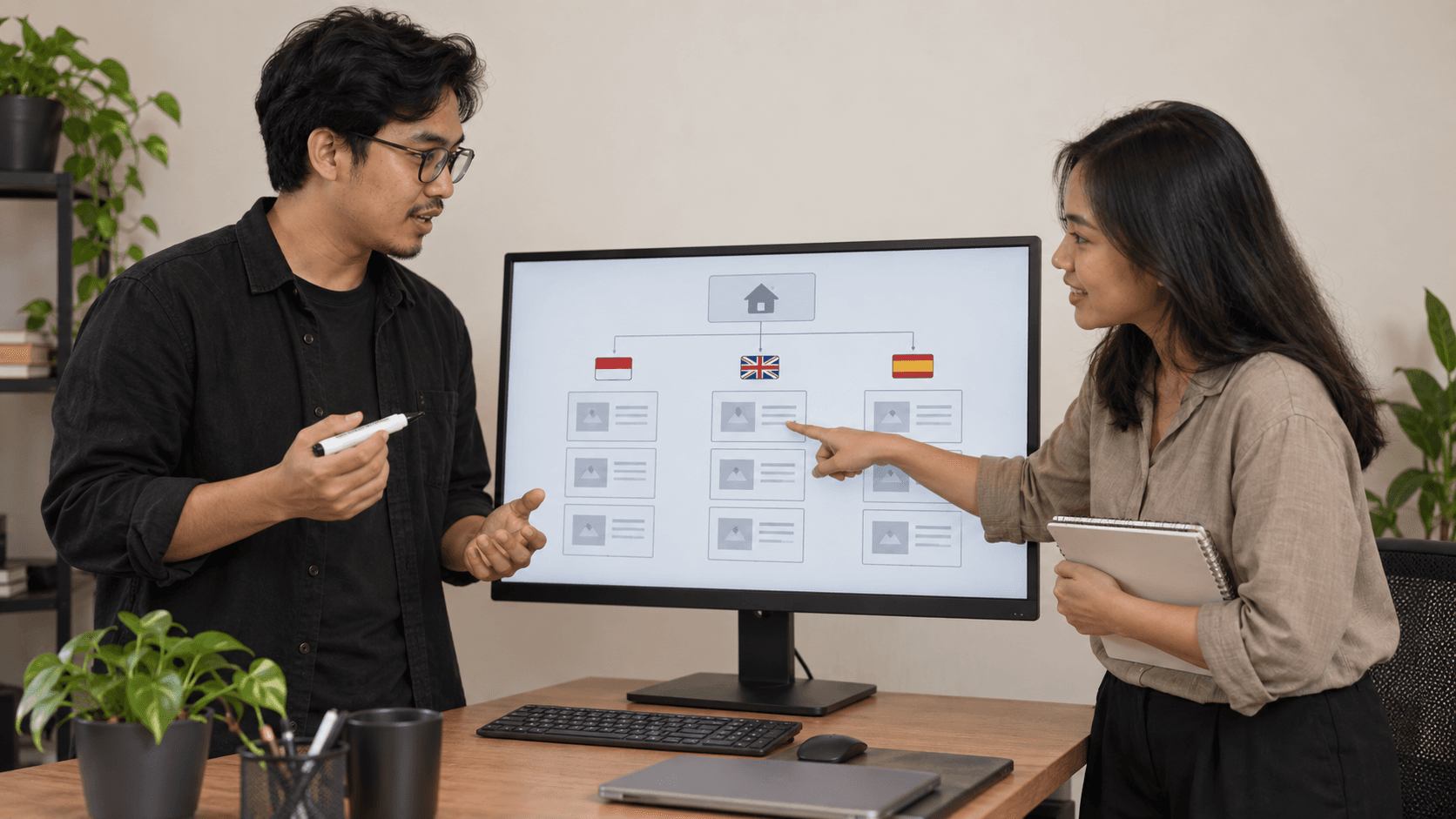
- English and Bahasa Indonesia pages need stable URLs, visible language-specific content and clear links between their equivalents.
- Canonical and
hreflangsignals should describe the pages that actually exist; tags cannot compensate for a machine-swapped or incomplete translation. - Audit a few commercially important page pairs before adding a second-language version across the whole site.
An Indonesian B2B company publishes an English site for regional buyers and a Bahasa Indonesia version for domestic teams. The menu switches language, but some pages load from the same URL and change text in the browser. Others have separate URLs yet point their canonical tag back to English. A buyer can sometimes read the right page; a search engine may have a much less reliable path to it.
Technical SEO is the practical work of making both versions identifiable, reachable and consistent. First decide which buyer questions need English or Bahasa answers. The site then has to deliver each intended answer at a URL people and search systems can use.
Give each version a dependable address
A language switch should lead to a distinct, stable URL for each page that the business wants indexed. The exact folder pattern is a site decision; consistency matters more than a fashionable code. A product page in English should have a clear counterpart in Bahasa Indonesia when that counterpart exists. If a page has no translation, the switch should say so or take the visitor to a sensible related destination rather than pretending every page has an equivalent.
Avoid relying on browser settings alone to choose the content at one URL. A visitor may want to share the Bahasa page with a colleague whose device language is English. A crawler may not encounter the same version a human saw. A stable address makes the page directly shareable, inspectable in Search Console and eligible for its own search appearance.
The page must contain the language it claims to serve. A Bahasa heading above an English body isn't a complete version. Nor is a machine translation ready for publication if it changes a technical specification or commercial condition. A fluent reviewer should check the terms buyers use, the examples and the promised next step.
Make canonical signals match the page's role
A canonical tag identifies the preferred URL among duplicate or very similar pages. It isn't a general instruction to send every translation to the English original. When two pages are genuine language versions intended for search, examine whether each should identify itself as canonical. A site that points all Bahasa pages to English can undermine the purpose of maintaining separate versions.
Google's multi-regional and multilingual guidance describes hreflang and sitemap methods for indicating alternate pages. These relationships need correct language codes and URLs that actually resolve. A missing return link, a redirect to a different page or a tag pointing to an untranslatable destination can make the set difficult to interpret. Test the actual page pairs, not only a spreadsheet of intended URLs.
Check internal links as well. A Bahasa product page that sends every supporting link to English forces a reader to switch languages mid-journey. Some bilingual journeys are normal, especially when technical documentation exists only in English, but the link should make that clear. Where equivalent content exists, connect readers to it naturally.
Effective SEO for an Indonesian bilingual site has to support the buyer route as well as the technical signals. Search engines need coherent page relationships, and buyers need a path from a question to a service explanation they can act on.
Check what renders before diagnosing rankings
A page can have correct tags in a source template and still fail when its content is rendered. Inspect the HTML that search engines receive, especially on a JavaScript-heavy site. Google's JavaScript SEO guidance explains how crawling and rendering can affect discovery. Confirm that the main copy, links, title and language switch are available in the rendered page, and that important content isn't behind an action a crawler cannot perform.
Review status codes and redirects for a sample of page pairs. A Bahasa URL that returns 200 to a browser but redirects to English for certain visitors needs closer examination. A page accidentally marked noindex won't be eligible to appear regardless of how well it is written. A sitemap can help discovery, but it doesn't override a page-level exclusion.
Use Search Console URL inspection for representative pages. Check which URL Google considers canonical, whether the page was indexed and what problems were reported. Don't infer that a page is healthy merely because it appears in a sitemap. Conversely, an indexed page is not proof that it satisfies a buyer question or ranks for the intended term.
Keep facts aligned as the site changes
The technical launch is only the beginning. Product limits, service coverage and pricing conditions can change. If an English update ships first and its Bahasa counterpart waits for months, the two pages may contradict each other during a live sales process. Assign a content owner to each pair and a release rule for high-risk claims. Both versions need to describe the same offer even when the wording and examples differ.
The contact route needs the same attention. A Bahasa page may invite a domestic enquiry, but if the form confirmation and follow-up arrive only in English, the journey changes at the point of highest intent. Test the page, form, confirmation and sales routing as one sequence. The answer on the page isn't complete if the buyer can't act on it.
Prioritise pages by business importance. Start with the services that generate qualified enquiries, the product comparisons buyers request and the documentation that affects implementation decisions. A second-language version of every old blog post may add maintenance cost without improving an actual buyer journey. A smaller set of accurate, accessible pages gives the team a better base to expand.
Test Technical SEO on Real Indonesian Page Pairs
Select three English/Bahasa pairs that matter to current opportunities. Follow both versions from search result to contact action, then inspect their rendered content, canonical URLs, alternates and links. Fix the mismatches before scaling the pattern. If your team needs help with that review, speak with Digital Squad about an Indonesian SEO audit tied to the pages buyers actually use.